Leaderboards in Gamification: 5 Real App Examples Analysed

The instinct when building a leaderboard feature is to rank everyone against everyone else. This is almost always the wrong design. A global ranking across 100,000 users motivates approximately the 100 people who can realistically see themselves competing for a top position. For the other 99,900, a number that reflects how far they are from the top is not a motivator — it is a reason to disengage.
What makes leaderboard design interesting is that the same mechanic produces completely different outcomes depending on five variables: the size of the reference group, what's being competed on, how frequently the rankings reset, whether rank can be lost as well as gained, and whether the competition serves a purpose beyond status. The five apps below each handle at least one of these variables differently from the default, and the design choice in each case is worth understanding.
Duolingo: Why the Threat of Demotion Outperforms the Promise of Promotion
Duolingo's league system places users in weekly groups of roughly 30 learners, ranked by XP earned during the week. At the end of each week, the top performers are promoted to a higher league and the bottom performers are demoted to a lower one. Both the promotion opportunity and the demotion threat are visible to users throughout the week.
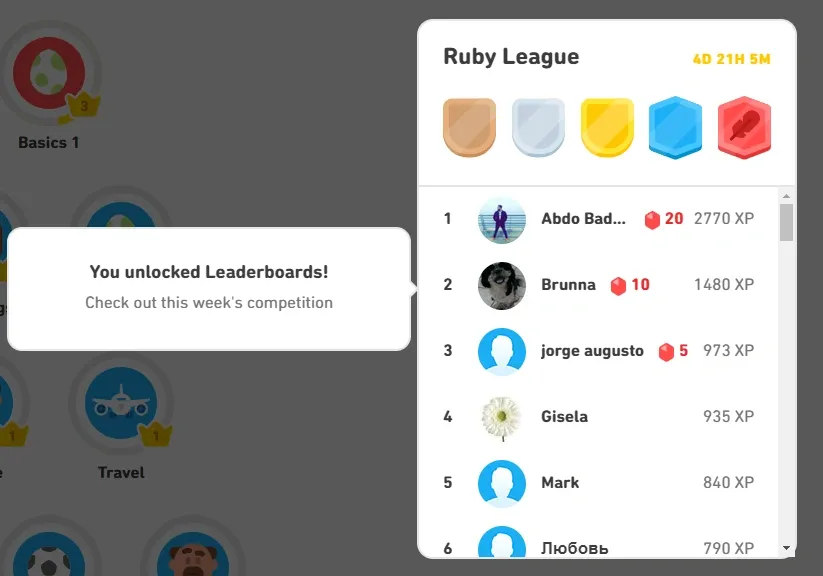
The design insight here is that loss aversion and achievement motivation are different psychological mechanisms, and they activate at different points in the week. Early in the week, when promotion is plausible, users are motivated by the prospect of moving up. Later in the week, once position has solidified, the more powerful driver for mid-table users is avoiding the drop. The demotion threat is more consistent as a re-engagement mechanism precisely because it is available to all users who are not already at the bottom — a much larger segment than those who can realistically promote.
The weekly reset matters as much as the demotion mechanic. Without it, early users accumulate insurmountable leads and the competitive context collapses for everyone who joins later. The reset creates a fresh competitive window every seven days, which means every user, regardless of their history on the platform, starts each week with a realistic path to their current league's top positions.
Fitbit: The Friend Reference Group
Fitbit's leaderboard shows step counts for your friends and family — people you have explicitly connected with — rather than a global or even a regional ranking. This is a specific design choice with a specific psychological effect: the reference group contains people whose opinions matter to you personally, which changes the social stakes of every position.
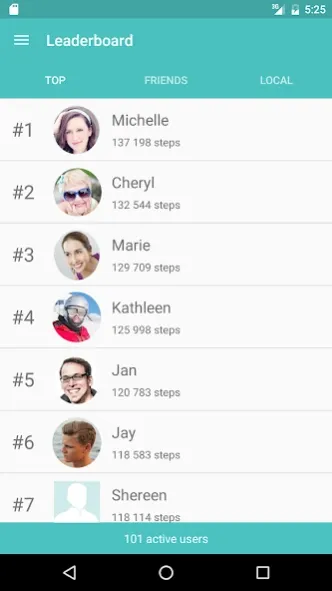
Being ranked fifth in the world in step count is an abstraction. Being ranked last among your seven friends this week is concrete and personal. The motivation to improve your position is qualitatively different because the audience is people you know. The same logic that makes StickK's named referee more effective than an anonymous leaderboard applies here: personal social obligation produces more consistent behaviour change than anonymous competitive pressure.
Fitbit's friend leaderboard also sidesteps the attainability problem that plagues global rankings. In a friend group of eight, every user can realistically finish first or avoid finishing last in any given week. The competitive pool is small enough that position is always meaningful and movement is always possible. The tradeoff is that the competitive intensity is lower than a global ranking would produce among its top performers — but Fitbit's user base is predominantly casual fitness trackers rather than competitive athletes, so that tradeoff is correctly calibrated.
Memrise: Weekly Resets and the Permanent Hierarchy Problem
Memrise ranks users by points earned within a weekly window rather than all-time. This seems like a minor implementation detail but solves a problem that destroys engagement in many leaderboard systems over time: permanent hierarchies.
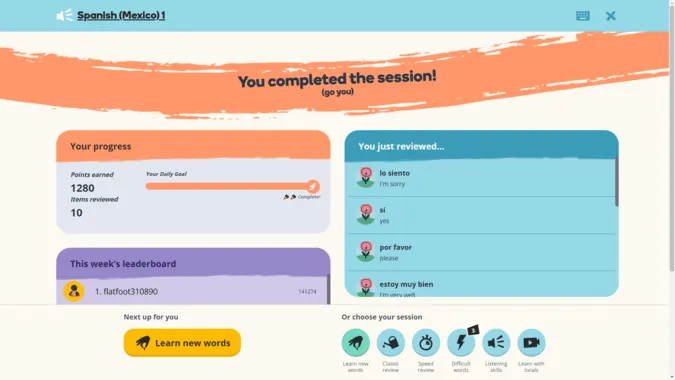
In an all-time leaderboard, users who joined early and accumulated points when they were most engaged build leads that later joiners cannot close. A user who signs up today and sees themselves ranked 15,000th globally behind users who have been on the platform for three years has no realistic competitive context. The competition is over before it starts for anyone who is not an early adopter or a power user.
Weekly resets eliminate this dynamic. A user who starts Memrise today is competing for this week's rankings on equal footing with users who have been on the platform for years. Every new user has immediate access to a winnable competitive context. The cost of this design is that all-time achievement is not recognised on the leaderboard itself — which is why Memrise also maintains a separate points and badge system for cumulative recognition. The two mechanics serve different needs: weekly leaderboards for competitive re-engagement, cumulative points for progress recognition.
Charity Miles: When the Competition Has a Purpose Beyond Status
Charity Miles awards money to a charity of the user's choice based on distance walked, run, or cycled. The app's leaderboard ranks users by mileage and fundraising impact, which means climbing the leaderboard has a tangible prosocial outcome: the higher you rank, the more you have contributed to your chosen cause.
This changes the motivational frame of the competition meaningfully. A standard leaderboard competition produces status as its primary reward — you rank highly because you are better than others, and the reward for that is recognition. Charity Miles' leaderboard produces prosocial impact as its primary reward — you rank highly because you have contributed more, and the reward for that is knowing the contribution happened. These are different enough as motivations to attract different users and produce different emotional responses to rank position.
The design lesson is that the meaning attached to leaderboard position shapes the psychological experience of competing, independent of the mechanics themselves. For apps where the core activity already has intrinsic value — exercise, learning, creative work — tying the leaderboard's recognition to that value rather than to abstract status can extend the motivational reach of the mechanic to users who are not primarily status-driven.
Run an Empire: Leaderboard as Core Game Loop
Run an Empire is a location-based strategy game where running physically claims territory in the real world. Users run through neighbourhoods to conquer them, and the leaderboard ranks players by territory controlled, distance run, and conquests achieved. This is different from every other app in this post because the leaderboard is not a feature layered on top of a core product — it is the core product.
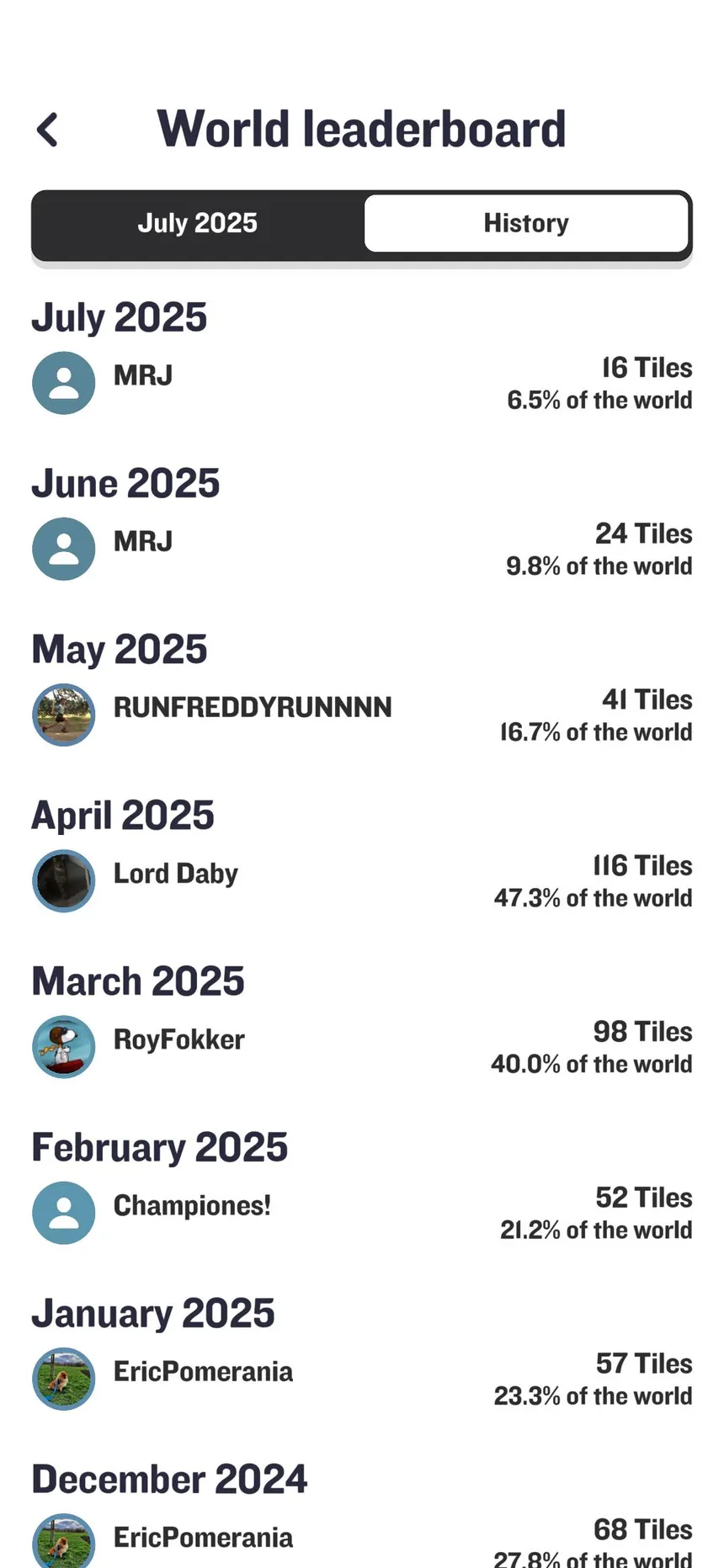
When a leaderboard is peripheral — a tab in a fitness tracker, a page in a learning app — users engage with it intermittently and its motivational effect is bounded by how often they check it. When the leaderboard is the game, every run has immediate competitive stakes and the re-engagement driver is continuous. A user who has not run since yesterday has lost a day of territory defence; the leaderboard position is literally deteriorating in real time.
The practical lesson for product teams is about integration depth rather than about location-based gaming specifically. A leaderboard that is deeply integrated into the core activity — where running changes the leaderboard changes the game state — produces qualitatively more engagement than one that sits in a separate section and reflects activity that the user was going to do anyway. The question worth asking when designing leaderboard features is not "how do we show users their rank?" but "how do we make rank change an event that matters to users in the moment?"
What These Five Implementations Share
The design principle across all five apps — despite their different categories, audiences, and mechanics — is that the leaderboard's reference group and reset period are the variables that determine whether the mechanic sustains broad engagement or concentrates it among a small competitive elite.
Duolingo's league groups are small (roughly 30 users) and reset weekly. Fitbit's leaderboard is limited to personal friends. Memrise resets weekly. Charity Miles uses multiple leaderboard categories to create different competitive contexts. Run an Empire makes rank change continuous. In every case, the design ensures that a meaningful proportion of users have a realistic competitive context — something to gain, something to defend, something to measure their activity against that feels winnable.
The four enterprise sales platforms omitted from this analysis — MindTickle, Centrical, Ambition, Xactly Incent — follow different design principles because they serve different purposes. In a managed performance context, the goal of a leaderboard is transparent performance visibility for both employees and managers, not user-initiated competitive engagement. The design requirements for that use case — typically global rankings, all-time or quarterly reset periods, management visibility — are largely opposite to what produces engagement in consumer apps. Building leaderboards for B2C user engagement means designing around attainability. Building them for enterprise performance management means designing around accountability. These are different problems and should be treated as such.
Frequently Asked Questions
What is a leaderboard in app gamification? A leaderboard ranks users against each other based on a defined performance metric — steps taken, XP earned, distance run, points accumulated — and displays those rankings within the app. The mechanic taps into competitive motivation: users are driven to improve their position, defend it against others, or avoid falling to lower ranks. The effectiveness of a leaderboard depends heavily on the design of the reference group, the reset period, and how closely the ranking metric maps to the behaviour the app actually wants to drive.
Why do global leaderboards often fail to drive retention? A global leaderboard only motivates users who can realistically see themselves competing for a high position — typically a small fraction of any large user base. For the majority, a ranking that places them thousands of positions from the top is not a competitive context; it is a reminder of how far they are from mattering. Segmented or friend-based leaderboards fix this by shrinking the competitive pool to a size where winning is attainable for a much broader proportion of users. Duolingo's league system, Fitbit's friend leaderboard, and Strava's segment architecture all reflect this design principle in different ways.
Should leaderboard rankings reset periodically? For most consumer apps, yes. An all-time leaderboard creates permanent hierarchies where early users or power users accumulate leads that new users cannot close. This makes the competitive context inaccessible to anyone who was not an early adopter, reducing the leaderboard's motivational value for the majority of the user base over time. Weekly or monthly resets give every user, regardless of when they joined, access to a fresh competitive window with a realistic path to recognition. The tradeoff is that cumulative achievement is not captured by the leaderboard itself — a separate points or achievement system handles that function.
What is the difference between promotion/demotion leaderboards and static rankings? Static leaderboards show your current rank and let you move up or down based on activity. Promotion/demotion systems, like Duolingo's leagues, divide the user base into tiers and explicitly promote top performers to a higher tier and demote bottom performers at the end of each period. The key difference is that demotion creates a loss aversion trigger that static rankings do not — users in the middle of the ranking are motivated not just by the possibility of moving up but by the threat of moving down. This threat tends to be more consistent as a re-engagement driver than the promotion opportunity, because it is available to a larger segment of users throughout the competitive window.
When do leaderboards hurt retention rather than help it? Leaderboards hurt retention when the competitive context is unwinnable for the majority of users — typically in global all-time rankings where early users have permanent leads — or when the metric being ranked is misaligned with what users care about. A leaderboard that ranks users by session frequency in a productivity app can create the proxy metric problem: users optimise for ranking rather than for actual productivity. Leaderboards also backfire in categories where users have widely disparate skill levels and the lower-skilled majority consistently loses. The diagnostic question is whether the users who rank lowest have a realistic path to improving their position — if they do not, the leaderboard is producing disengagement for the majority.
How do I build a leaderboard for my app with Trophy? Trophy's Leaderboards API supports real-time rank updates, attribute-based segmentation (for friend groups, teams, or location-based pools), configurable reset periods, and webhooks for rank change events that can trigger push notifications. The full implementation guide is in Trophy's leaderboards documentation. For a deeper look at how segmented leaderboards work mechanically and what they cost to build from scratch, see our guide to Strava's segmented leaderboard approach.
Conclusion
The leaderboard is the gamification mechanic most likely to be implemented wrong on the first attempt. The default — rank everyone against everyone, display the result, refresh when activity changes — produces a feature that serves roughly 1% of users well and generates mild resentment in everyone else.
The five implementations above demonstrate that the design decisions around reference group size, reset frequency, what the ranking represents, and how deeply the leaderboard integrates with core activity are what separate a retention driver from a list of numbers nobody checks. Getting those decisions right is available to any product team. It just requires treating the leaderboard as a design problem rather than a database query.
For the technical detail on segmented leaderboards specifically — including the backend architecture and Trophy's implementation approach — see our guide to how Strava uses segmented leaderboards.
Get the latest on gamification
Product updates, best practices, and insights on retention and engagement — delivered straight to your inbox.